What to Wear to a Job Interview (Without Overthinking It)
A clear, current guide to what to wear to a job interview — how to read the dress code, what business casual really means, and what quietly sinks candidates.
What to Wear to a Job Interview (Without Overthinking It)
Match the company's everyday dress code, then go one notch cleaner and more conservative. When you can't tell what's normal, default to business casual: neat, fitted, unwrinkled, and low on distraction. That single move beats both a rumpled t-shirt and a stiff three-piece suit in almost every interview room.
What should you wear to a job interview?
Dress one level more polished than what the company's employees wear on an ordinary day, and fall back on business casual when you genuinely don't know their norm. A boutique law firm and a five-person startup are not playing the same game, so "dress professionally" by itself isn't useful advice — it only works once you calibrate it to the room you're walking into.
Three things do almost all the work: fit, cleanliness, and restraint. Clothes that actually fit read as more competent than clothes that are merely expensive, and wrinkles, scuffed shoes, or visible stains undercut everything else you're wearing. Restraint means subtracting, not adding — skip the jangly bracelet, the heavy cologne, the tie that fights your shirt. Nail those three and the interviewer's attention stays on your answers, which is the actual point of getting dressed in the first place.
First, read the room: match the company, then go one level up
The right outfit is relative, not absolute — a tech startup and a law firm expect close to opposite things, and guessing wrong in either direction costs you. Overdress at a scrappy startup and you can look like you don't get the culture; underdress at a white-shoe firm and you can look like you don't get the stakes.
Do the research before you pick the outfit, not after. Check the company's careers page and team or "About" photos for a visual sense of daily wear, then scroll a few employees' LinkedIn profiles for candid shots — headshots lie, candid photos don't. If you're still unsure, just ask the recruiter directly: "Is there a dress code I should know about for the interview?" is a completely normal question, and recruiters field it constantly.
If you're new to the field entirely, the Occupational Outlook Handbook is a free starting point — its occupation pages describe typical work environments, a decent proxy for how formal the wardrobe culture runs. Once you know the daily norm, go one notch above it: if employees wear jeans and hoodies, you wear dark jeans or chinos with a collared shirt; if the office is already business casual, you show up on the sharper end of business casual.
Video interviews get their own rule: dress your top half exactly as you would in person, jacket included, not just from the collar up. You may need to stand, reach for something, or turn mid-call, and a mismatched bottom half is a real, if funny, risk. Test your lighting and camera framing beforehand, and sit somewhere with a plain, tidy background — that's effectively part of the outfit now too.

What "business casual" actually means
Business casual is the safe default for most interviews, and it's more specific than the phrase suggests. It sits between a full suit and streetwear — put together, not a costume.
On the ground, it usually looks like:
- Pressed slacks, chinos, or a tailored skirt/dress
- A collared shirt, blouse, or clean sweater
- A blazer if you want the extra polish (you usually can, and it rarely hurts)
- Closed-toe shoes in good condition
- Minimal, non-noisy jewelry and accessories
It crosses into too-casual the moment sneakers (unless the office genuinely lives in them), graphic tees, visible logos, ripped denim, flip-flops, or gym wear show up — a fast way to look like you didn't take the meeting seriously, even with great answers.
Here's the part people underrate: fit and grooming move the needle more than price does. A $60 shirt that's actually tailored to your body beats a $300 shirt that's a size off, and wrinkle-free, properly hemmed, and clean beats "expensive but sloppy" every time. It's also the cheaper problem to fix — a $10 trip to a tailor usually solves it.
What quietly sinks candidates
Most attire mistakes aren't about being underdressed — they're about being distracting. An interviewer mentally cataloging your wrinkled shirt, strong perfume, or jangling bracelet is an interviewer only half-listening to your answer.
The usual suspects: visible wrinkles or lint, cologne or perfume applied too heavy for a small room, jewelry or heels that click and clatter, and clothes that are noticeably too tight or too loose. None of these are moral failings — they're just noise, and noise competes with the thing you actually want them to remember, which is you.
There's a less obvious mistake on the other end: dressing so formal that you look uncomfortable in your own clothes. A full suit at a casual creative agency can read as stiff or out of touch rather than "trying hard," and it can make you visibly fidget in a way that undercuts your confidence. Comfort and fit matter as much as formality — an outfit you keep tugging at is working against you the whole time.
A useful shortcut is the "3-3-3" idea: roughly three main pieces (top, bottom, layer), three colors max, three accessories max. It's not a rulebook, it's a ceiling — a way to stop yourself from overthinking an outfit into visual clutter the morning of. The goal is the same one that applies to how you introduce yourself once you're in the room: clear, confident, and not competing with itself for attention.
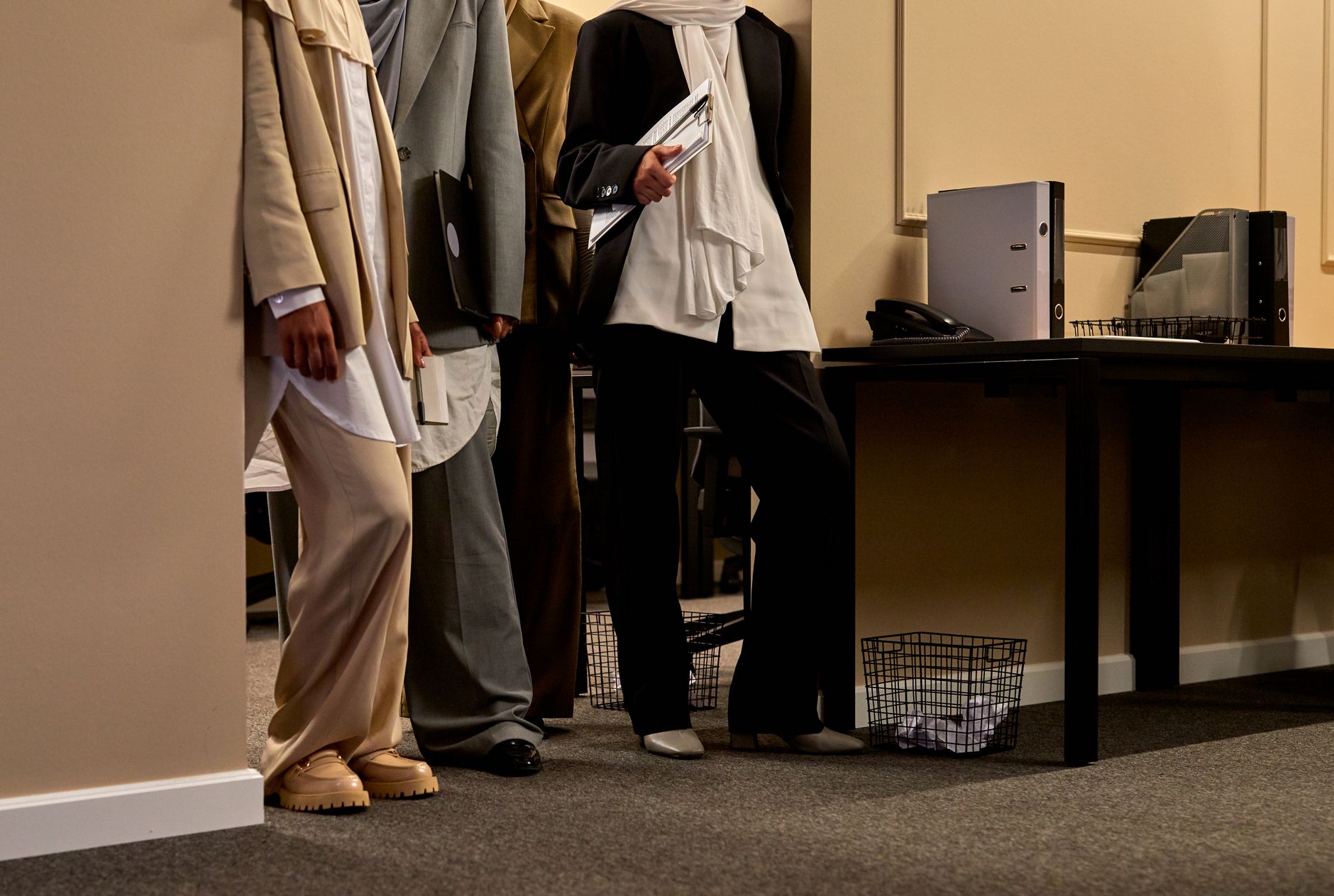
Industry cheat sheet
Dress codes cluster by industry, so calibrate to yours instead of guessing from a generic list. These are starting points, not laws — always weigh them against what you actually saw when you researched the specific company.
- Corporate, finance, law, government: A suit (or blazer plus dress pants or skirt) is still the safe standard, in conservative colors — navy, charcoal, black — with minimal accessories.
- Tech, startups, most creative fields: Smart casual is the sweet spot: dark jeans or chinos, a collared shirt or nice top, blazer optional. A full suit here can work against you by signaling you skipped the culture research.
- Retail, hospitality, service roles: Clean, approachable, and on-brand matters more than formal. Look at what the staff actually wears on the floor and mirror a slightly tidier version of it.
- Healthcare, education, nonprofit: Business casual is the near-universal default — professional but not stiff, since these roles are often people-facing all day.
When an industry doesn't fit neatly into a bucket, the "one notch above the daily norm" rule from earlier is your tiebreaker. It's rarely wrong.
Getting the outfit right buys you something bigger than a good first impression: it frees up mental bandwidth for the parts of the interview that actually decide the outcome, including the questions you ask them at the end. Clothing is table stakes, not the differentiator — once it's handled, spend your prep time where it counts.
If you'd rather not leave that prep to guesswork, Land the Offer with AI is a plain-language playbook for using ChatGPT as your job-search co-pilot — tailoring your resume to each posting, drafting cover letters, rehearsing interview answers, and negotiating the offer once you get it.
Frequently Asked Questions
Is business casual OK for a job interview?
Yes, for most roles business casual is the safe choice. Go one notch cleaner than the company's daily norm, keep everything fitted, and skip anything loud enough to distract from what you're actually saying.
What should I avoid wearing to an interview?
Avoid anything that distracts: wrinkles, strong cologne or perfume, noisy jewelry, and clothes that don't fit well. The goal is for the interviewer to remember you, not your outfit, so if a piece is fighting for attention, leave it home.
What do I wear to a video interview?
Dress your top half exactly as you would in person, test your lighting and background beforehand, and avoid busy patterns that shimmer or strobe on camera. Stand up once before the call starts to confirm your bottom half is presentable too, just in case.
Should I always wear a suit?
No. A suit fits corporate, finance, and law, but in tech, startups, or creative roles it can read as out of touch rather than polished. Match the company's daily norm first, then go one level up from there.